⚓ The Venetian Harbour & Lighthouse 2 min walk
Built in the 14th century and still the most beautiful place in the city — arguably the most beautiful harbour in Greece. Pastel Venetian and Ottoman mansions curve around the waterfront; fishing boats and yachts rock where war galleys once docked. At the far end of the long breakwater, the lighthouse stands 21 metres tall — built by the Venetians, rebuilt in its present minaret-like form by Egyptian craftsmen around 1830. Walk the breakwater at sunset for a 360° panorama of the harbour and the White Mountains behind the city. There is no more perfect moment in Chania.
🏰 Firkas Fortress & Maritime Museum 5 min walk
The great Venetian fortress at the northwest corner of the harbour was completed in 1645 — just in time for the Ottoman conquest. Today it houses the Maritime Museum of Crete: ship models, nautical instruments, and a moving section on the Battle of Crete in 1941. From the battlements, the view across the harbour is among the best in the old town. It was here, on 1 December 1913, that the Greek flag was raised over Crete for the first time, ending 250 years of Ottoman rule. Entry €2.
🕌 Küçük Hasan Mosque — Yiali Tzami 5 min walk
Sitting directly on the waterfront at the curve of the harbour, this 17th-century mosque is the oldest surviving Muslim building on Crete — built in honour of the first Ottoman commander of Chania. A superb specimen of Islamic architecture in an overwhelmingly Greek coastal setting. Today it operates as an art gallery and exhibition space. The reflections of its arches in the harbour water at dusk are extraordinary. Free entry.
⛵ The Venetian Arsenals — Neoria 8 min walk
Eight stone-vaulted shipyards stretch along the east side of the harbour — built by the Venetians to construct and maintain their war galleys. Their soaring arches and sheer scale create one of the most theatrical backdrops in the old town. The largest, the Grand Arsenal, has been restored and now houses the Centre for Mediterranean Architecture, with art and architecture exhibitions year-round. Walking the quay past the Neoria on an evening, with the light slanting through the arches, is one of the essential experiences of Chania.
🏛 The Archaeological Museum 8 min walk
Housed in the magnificent former Venetian Monastery of Saint Francis — the largest Venetian church ever built on Crete — this is the unmissable stop for anyone who wants to understand western Crete's extraordinary depth. The collection covers the Neolithic through the Roman period, with particular strength in the Minoan era: Linear A and B tablets, elaborate pottery, jewellery, clay figurines, and finds from the Minoan city of Kydonia directly beneath the nearby hill. The Roman mosaic floors and Hellenistic gold jewellery collections are outstanding. Allow at least 90 minutes. Entry €4, Tue–Sun.
✡ Etz Hayyim Synagogue 8 min walk
Hidden in the narrow lanes of the Evraiki quarter, Etz Hayyim — "Tree of Life" — is the only surviving synagogue in Crete and the sole remaining monument to a Jewish community that lived on this island for over 2,000 years. In May 1944, the 263 Jewish residents of Chania were arrested and deported by the Nazis; the ship sank on 9 June 1944 with no survivors. The ancient community of Crete ended that day. The synagogue was saved from ruin in 1995 and reopened in 1999 as a place of prayer, recollection, and reconciliation — words inscribed at its entrance. It is a deeply moving place.
🕍 Splantzia Quarter & Church of Agios Nikolaos 10 min walk
The Ottoman quarter at the southeast edge of the old town is the most atmospheric neighbourhood in Chania for an evening wander. Its centrepiece, Plateia 1821, is ringed with kafeneia and restaurants that are genuinely local — this is where Chania's residents eat. The nearby Church of Agios Nikolaos carries its history visibly: a full minaret on one side and a bell tower on the other, having served as a mosque under Ottoman rule. Both survive side by side, the most vivid symbol of this layered city.
🏺 Kasteli Hill & Minoan Kydonia 10 min walk
The low hill at the centre of the old town sits directly on top of the ancient Minoan city of Kydonia — one of the great Bronze Age cities of Crete, inhabited since the Neolithic. Excavations have been underway since the 1960s; fragments of Minoan villas, storage complexes and streets are visible in open excavation plots between the houses. Follow Afentoulief Street to the top for a panoramic view across the whole harbour. The Byzantine walls on the seaward side of the hill are another survival worth seeking out.
🧀 The Municipal Market — Agora 12 min walk
Built in 1913 in the shape of a cross — modelled on the covered market of Marseille — the Agora is both a working market and one of the most characterful buildings in Chania. Under its stone arches: Cretan herbs, wheels of graviera and mizithra cheese, wild thyme honey, olives, olive oil, leather goods, and Cretan knives. Still primarily a local market, especially in the mornings — go early, before the heat and tour groups arrive. The cheese stalls alone are worth the visit. Mon–Sat 8am–8pm, free entry.
🚶 Topanas & the Venetian Lanes 3 min walk
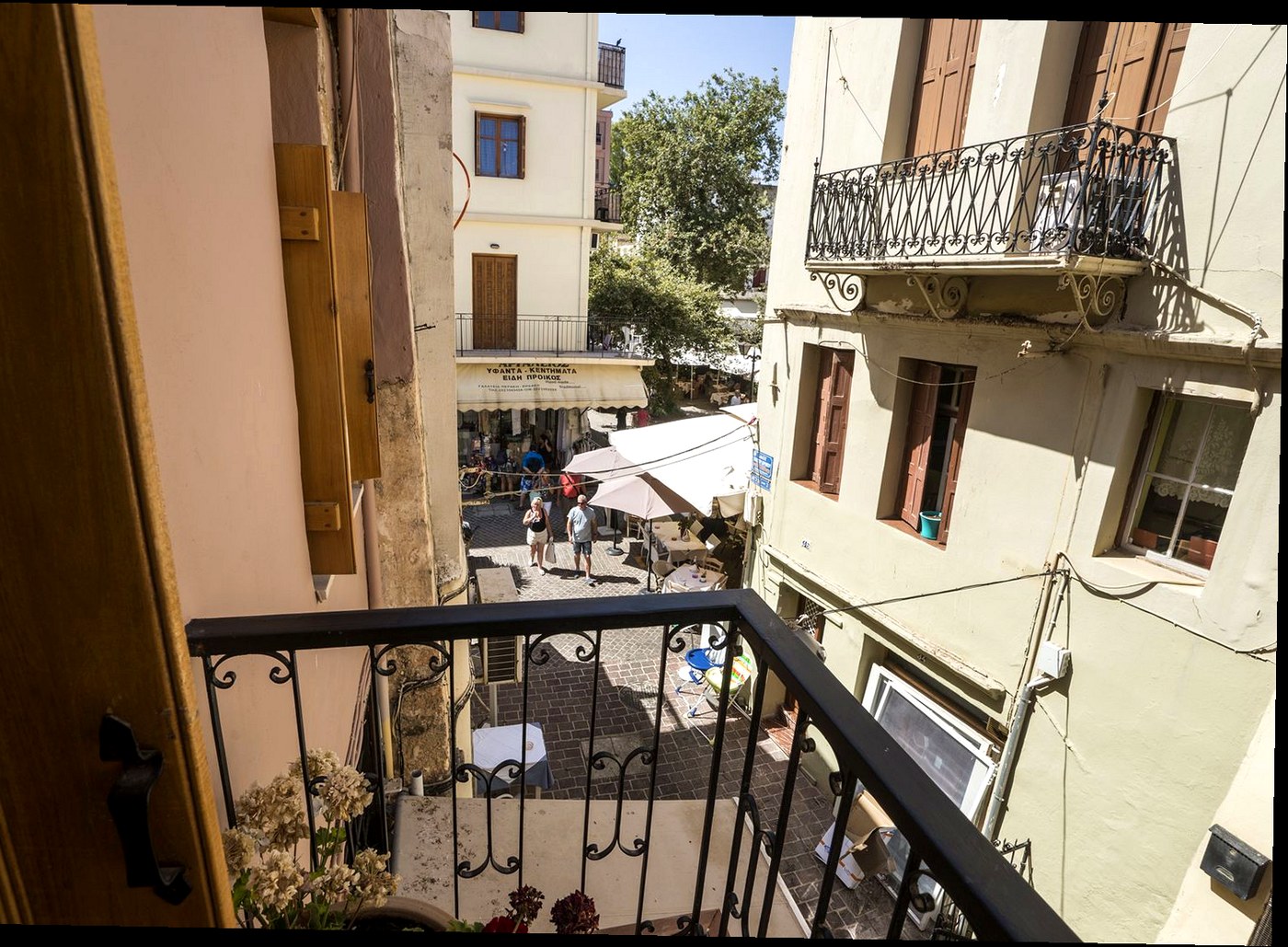
The Topanas district west of the harbour is the heart of the old town. Streets like Angelou, Theotokopoulou, and Zambeliou are lined with restored Venetian and Ottoman mansions — carved stone doorways, colourful shutters, jasmine-covered balconies now housing boutique hotels, wine bars, and jewellers. No map does justice to these lanes. The correct approach is simply to walk in and allow yourself to get lost; the old town is small enough that you will always find the harbour again. Theotokopoulou Street in particular is one of the most beautiful streets in Greece.